
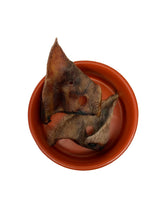
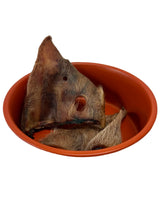


Dehydrated Pig Ears
Slow Dehydrated. Single Ingredient. Real Pig Ears.
A satisfying chew with a nutritional profile that does far more than keep your pet busy. Our Dehydrated Pig Ears are minimally processed, completely natural, and sold exactly as nature made them.
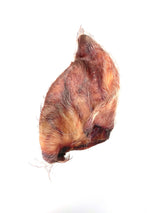
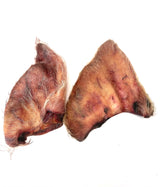
Pig ears are a classic chew for a reason. They are tough enough to hold a dog’s attention, gentle enough for most chewers, and loaded with connective tissue, cartilage, and skin that deliver real nutritional value with every bite. Slow dehydration preserves the natural structure of the ear without the use of any additives, preservatives, or synthetic ingredients. These come with some natural fur on them. The fur is fully digestible and acts as a gentle fiber source to support healthy gut motility.
Nutritional Profile
Pork Ear, Raw (Pre-Dehydration Basis)
Approximate values per 100g raw weight — Source: USDA FoodData Central, Pork, fresh, variety meats and by-products, ears, frozen, raw (SR Legacy #167857)
* Nutritional values are sourced from USDA FoodData Central (Pork, fresh, variety meats and by-products, ears, frozen, raw — SR Legacy #167857) and reflect the raw pre-dehydration state. Dehydration removes moisture and concentrates nutrients by weight, so actual nutrient density per gram of finished product will be higher than values shown above.
Raw Feeding Fact
Pig ears are one of the most glycine-dense chews available, with raw pork ear containing 4.4g of glycine per 100g. Glycine is the most abundant amino acid in the body’s connective tissue, but it is also a critical precursor to glutathione, the body’s primary antioxidant. Research has shown that many dogs and cats produce insufficient glycine endogenously to meet their metabolic demands, making food-sourced glycine particularly valuable. Whole-prey and organ-rich raw diets tend to supply it naturally; most commercial kibble does not.